
From Vessel Identity to Vessel Intelligence
Marine Passport starts with the vessel’s identity, researches available marine records and other sources, and then uses AI-powered intelligence to connect information and reveal insights that would otherwise remain fragmented.
Vessel Lookup
What Is a HIN
Every Marine Passport starts with the vessel's identity.
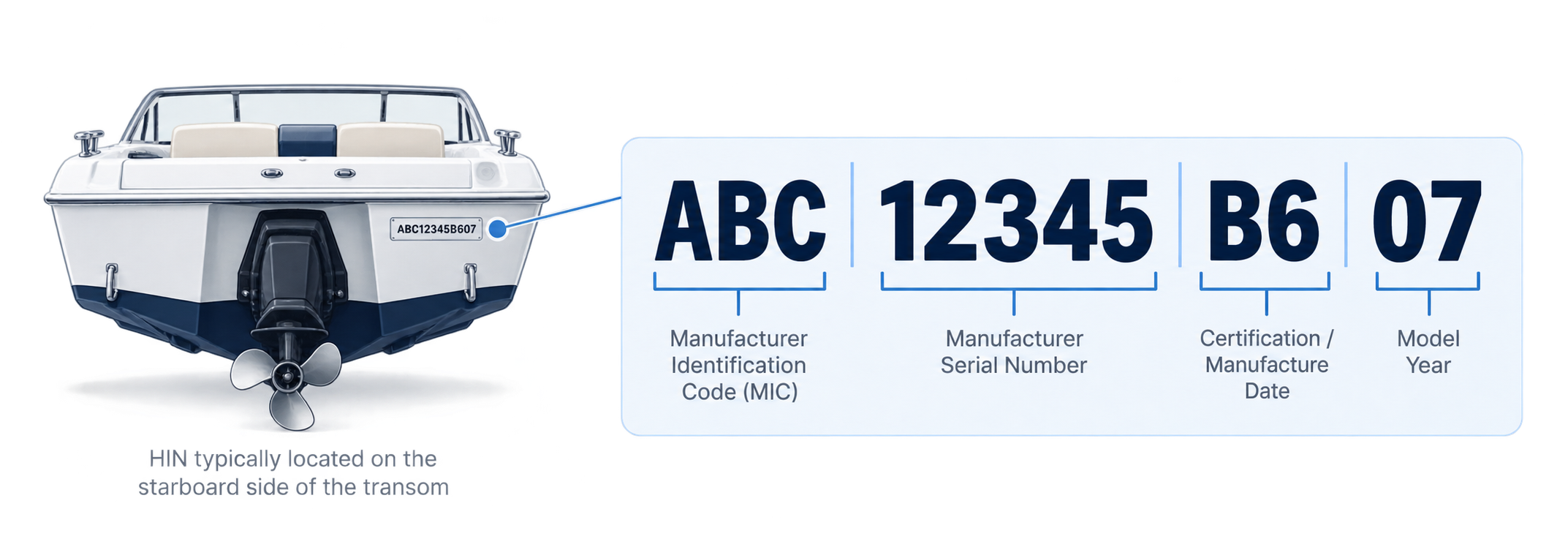
A Hull Identification Number, or HIN, is the primary identifying number used to identify a recreational boat. For boats subject to the federal HIN requirements, the modern HIN is a 12-character identifier that includes the manufacturer's identification code, a manufacturer-assigned serial portion, certification or manufacture date information, and model year.
You'll typically find the HIN on the starboard side of the transom. It may also appear on registration and other vessel documents. Because even a single incorrect character can point to a different vessel identity, the HIN gives Marine Passport the starting point for establishing the boat we're actually researching.
But a HIN is just the starting point, it doesn't unlock the complete history. Records associated with a vessel can exist under different identifiers and across different systems and sources. Marine Passport uses the HIN to begin establishing the vessel's identity, then looks beyond that single identifier to build a broader picture of the boat.
Why Marine Passport
There is no single source that tells a boat's entire story.
Unlike the automotive industry, marine information is recorded differently across federal and state agencies, manufacturers, service and technical sources, historical records, and other systems. Some records are public, some have limited availability, and others may never have been reported or digitized at all.
A vessel may also accumulate different identifiers over its life — including the HIN (if tampered), state registration number, and, when federally documented, the official number. Records associated with those identifiers do not live in the same system or follow the vessel in the same way.
Reporting practices, retention periods, privacy restrictions, source coverage, and simple errors or omissions can all affect what can be found. That means no legitimate marine-history report or service can promise a complete history of every vessel.
But, the challenge is not simply finding more records. It is determining which information belongs to the same vessel, how records from different sources relate to one another, and what can reasonably be concluded when those sources do not line up perfectly. A registration record may describe ownership and location, a federal record may follow documentation activity, manufacturer information may establish original configuration, and service or safety information may apply at the model, engine, or equipment level rather than to one individual hull.
That is why Marine Passport treats vessel research as an evidence-connection problem, not a database lookup. The process starts by establishing identity, expands outward to the available evidence, and then connects those findings to surface relationships, inconsistencies, and useful context.

1
Establish the vessel identity
Marine Passport begins with the HIN and available identifying information, then looks for additional identifiers and records that help establish how the vessel is represented across available current and historical sources.
2
Gather the available evidence
We search deeper across available marine records, documentation, historical activity, manufacturer and model information, specifications, factory power options, service and maintenance guidance, safety and recall notices, technical resources, and other vessel-specific sources.
3
Connect the pieces
Purpose-built AI helps compare information across the vessel, identify inconsistencies, connect findings across both public records and other sources, and surface useful context that individual data sources may not reveal on their own.
Understanding the Results
What a Marine Passport can — and can't — tell you.
Available information will vary
Every vessel has a different information footprint. Records may be unavailable, restricted, incomplete, outdated, or never reported or digitized.
Not every event leaves a record
If a reported accident, loss, service event, or other record isn't found, that does not establish that it never occurred.
Research compliments inspection
A Marine Passport adds information and context to the evaluation of a vessel. It does not replace a professional marine survey, mechanical inspection, sea trial, or other appropriate due diligence.
The goal isn't certainty where certainty doesn't exist. It's a better-informed understanding of the vessel before you make a decision.
Get Your Marine Passport
Don't settle for a vessel lookup. Demand vessel intelligence.
What's Inside:

Vessel identity verification
Registration & documentation
Damage, loss, & accidents
Reported activity
Specifications
Factory power options
Service, maintenance & recalls
Safety & recall information
Technical resources
AI-powered vessel intelligence
Ready to Get Started?
Select your search method to learn more about any US recreational vessel.